
Classroom lesson · Music · 🇬🇳 Guinea

Djembe Drumming

Guinea's gift to the world — the most famous hand drum on Earth

Photo · Wikimedia Commons

What is it?

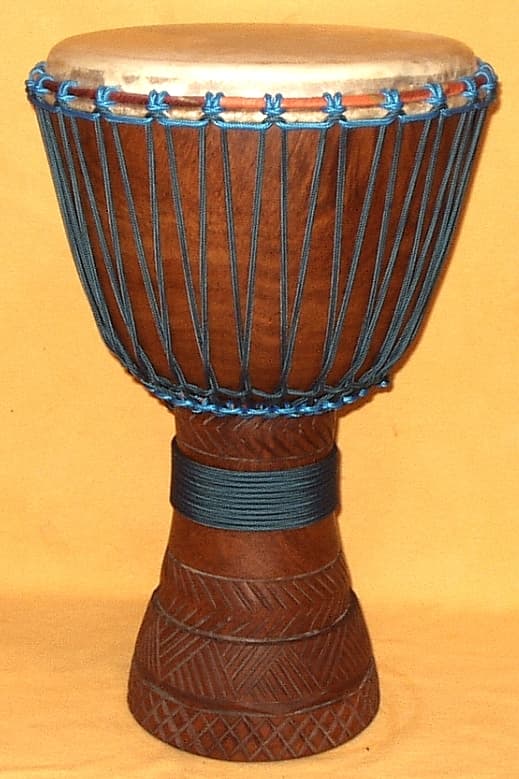
The djembe is a goblet-shaped hand drum that originated among the Mandé people of West Africa, and Guinea is considered its spiritual home. Covered with goat skin and carved from a single piece of hardwood, a djembe produces three main sounds — bass, tone and slap — and can be heard from a great distance. It is probably the most famous African drum in the entire world.

Tell me more

The djembe gets its name from a saying in the Bambara language: 'Anke djé, anke bé', meaning 'everyone gather together in peace'. The drum has always been more than just a musical instrument — it is a voice for the community, used to call people together, celebrate events, and accompany dances and ceremonies.

A master djembe player, called a djembéfola, trains for many years. Playing at a professional level requires extraordinary coordination, as different parts of the hand — the fingers, palm and fingertips — each produce a different sound. Many djembéfolas begin learning when they are very young children, sitting beside an elder and listening before they ever touch a drum.

Guinea has produced some of the most celebrated djembe masters in history. Groups like Les Ballets Africains — Guinea's famous national dance and drum company — took Guinean drumming to stages across Europe, North America and beyond, introducing the djembe to the whole world from the 1950s onwards.

Today the djembe is played on every continent. Music teachers use it in schools across Europe, Australia and North America because it is easy to begin learning and very enjoyable to play together in a group. Its roots, however, are firmly in Guinea and the wider Mandé world of West Africa.

In the classroom

Walk your class through this in 15 minutes.

Talk together

Discussion prompts

  1. 01The djembe's name means 'everyone gather together in peace'. Can you think of other instruments or traditions that are used to bring people together?
  2. 02Music from Guinea is now played in schools all over the world. How does music travel from one country to another?
  3. 03A djembéfola trains for many years. What other skills take a very long time to master, and why is it worth the effort?
  4. 04Why do you think a drum — not a singing voice or a flute — was used historically to call a whole community together?
Try this

Classroom activity

Try making a simple rhythm together as a class. Divide the class into three groups: one group claps a slow steady beat, one group claps twice as fast, and one group claps a short pattern on top. Listen to how the three rhythms fit together. This is how a djembe ensemble works — many rhythms layered into one sound.