
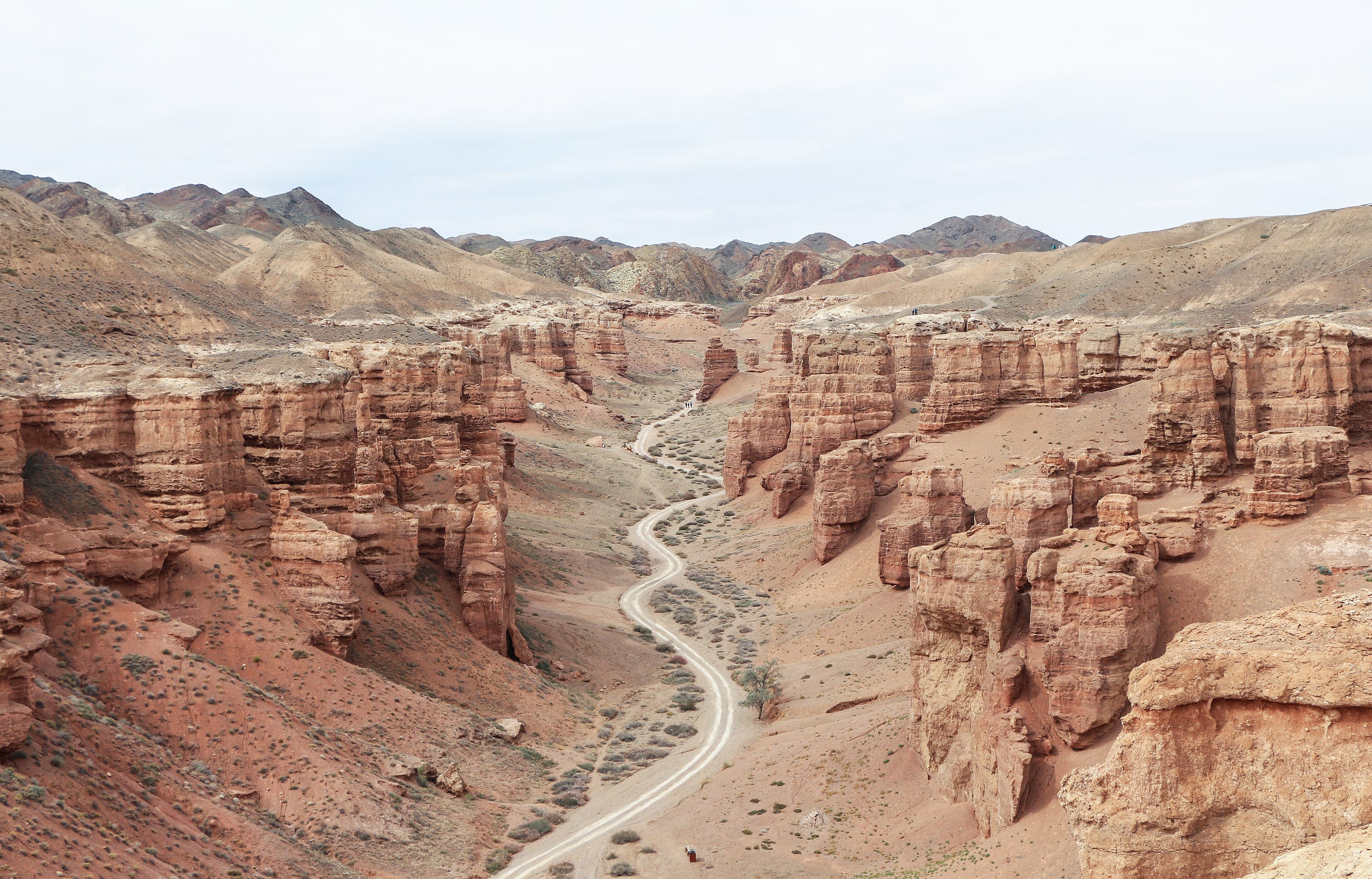
Classroom lesson ยท Charyn Canyon ยท ๐Ÿ‡ฐ๐Ÿ‡ฟ Kazakhstan

Charyn Canyon

A deep red canyon sometimes called the Grand Canyon's little brother

Photo ยท Wikimedia Commons

What is it?

Charyn Canyon is a dramatic gorge carved by the Charyn River in south-east Kazakhstan. The walls of red, orange and purple rock tower up to 300 metres above the canyon floor. It is sometimes called 'Kazakhstan's Grand Canyon' because the sculpted rock formations look so similar to those in the American west.

Tell me more

The canyon stretches for about 154 kilometres, making it one of the longest canyons in Central Asia. The most famous section is the Valley of Castles โ€” a stretch where the wind and rain have carved the rock into towers, spires and walls that look like the ruins of a giant fortress.

The rocks in Charyn Canyon are very old โ€” some layers were laid down millions of years ago, long before humans existed. Scientists can read the colours like the pages of a history book: each stripe of red, brown or cream represents a different era of the Earth.

The canyon is home to a special survivor โ€” the Sogdian ash tree. This tree grew here during the Ice Age and somehow managed to survive when most other trees of its kind disappeared. A small forest of these ancient trees grows right at the bottom of the canyon, near the river.

Visitors can walk along a path at the bottom of the Valley of Castles, with the towering red cliffs on either side. Eagles circle overhead, and in spring the canyon floor is dotted with wildflowers. At sunrise and sunset, the rock glows a deep, warm orange.

In the classroom

Walk your class through this in 15 minutes.

Talk together

Discussion prompts

  1. 01Wind and water carved Charyn Canyon over millions of years. What else can water and wind shape or change? Can you think of examples near where you live?
  2. 02Scientists read rock layers like pages in a book. If you were a scientist, what would you want to find out from the rocks?
  3. 03The Sogdian ash tree survived from the Ice Age. What does it mean for a species to be a 'survivor'?
Try this

Classroom activity

Using sand, clay or different coloured papers, create a model cross-section of a canyon. Layer different colours to show how rock layers build up over time. Label each layer with an imaginary era (e.g. 'Age of Dinosaurs', 'Age of Mammoths').