
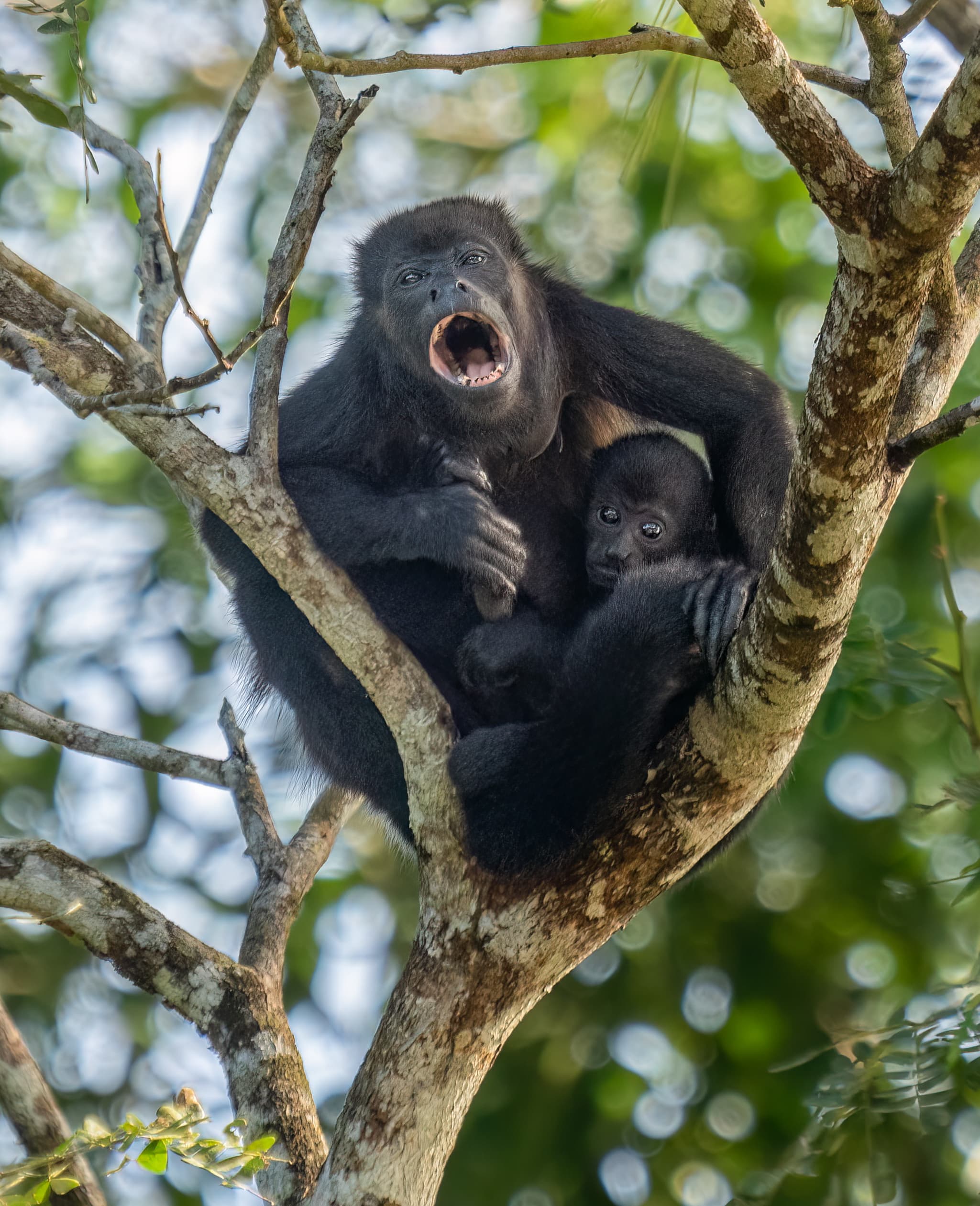
The secret of the howler monkey's enormous voice is a special hollow bone in its throat called the hyoid bone. This bone acts like a sound amplifier, turning a regular monkey call into something that echoes across the whole forest. When a group of howlers starts up in the early morning, the sound is so deep and powerful that people who hear it for the first time are often amazed - and sometimes a little startled.
Howler monkeys spend almost all their time in the tree canopy. They move slowly and carefully, using their long prehensile tail as a fifth limb to grip branches. They eat mostly leaves, which is unusual for monkeys - leaves are hard to digest and do not give much energy. This is why howlers move slowly and rest for long periods. They are saving their energy.
On Ometepe Island and in forests across Nicaragua, howler monkey troops are a common sight - and sound. A troop usually contains a few adult males, several females, and their young. They are mostly peaceful animals that prefer calling across distances to actually approaching each other. The morning chorus of a howler troop is one of the great sounds of the Nicaraguan jungle.
Howler monkeys are important seed dispersers. When they eat fruit, they carry the seeds through the forest in their stomachs and drop them far from the parent tree. This helps new trees grow in new places, keeping the forest spreading and healthy.