
Classroom lesson ยท Wildlife ยท ๐Ÿ‡ฆ๐Ÿ‡ด Angola

Giant Sable Antelope

Angola's national animal, with the most spectacular horns in the world

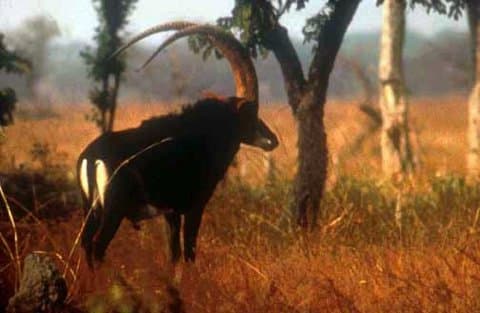
Male giant sable antelope with huge curved horns standing in golden grassland

Photo ยท Wikimedia Commons

What is it?

The giant sable antelope is Angola's national animal and one of the most magnificent creatures in Africa. Males have huge, sweeping horns that curve backward in a long arch โ€” sometimes measuring over 1.5 metres โ€” making them look like something from a fairy tale. They live only in Angola, nowhere else on Earth.

Tell me more

Male giant sable antelopes are jet black with a white belly and white face markings. Females are a rich chestnut brown. The males' horns sweep back in a dramatic curve, and older males can have horns so long that they almost touch their backs when the animal raises its head.

Giant sable antelopes live in a very small area of miombo woodland โ€” a type of open forest with tall, widely-spaced trees โ€” in central Angola. They graze on grasses and leaves and need this specific woodland habitat to survive. Because they live in such a small area and are only found in Angola, they are considered very rare and special.

The giant sable is so important to Angolan identity that it appears on the country's flag, its currency, and its national football team's badge. Angolans call the animal 'Palanca Negra Gigante', which means 'giant black palanca'. Protecting this magnificent antelope is a great source of national pride.

In the classroom

Walk your class through this in 15 minutes.

Talk together

Discussion prompts

  1. 01Why do you think it matters that an animal lives in only one country? What responsibilities does that give Angola?
  2. 02Many countries choose a special animal as a national symbol. What animal would you choose for your country, and why?
  3. 03What could schools, families and governments do to help protect a rare animal like the giant sable?
Try this

Classroom activity

Design an Angolan national animal poster. Draw the giant sable antelope in the centre, label its key features (black coat, white belly, curved horns), and write three facts around the outside. Add a border decorated with patterns inspired by Angolan art.