
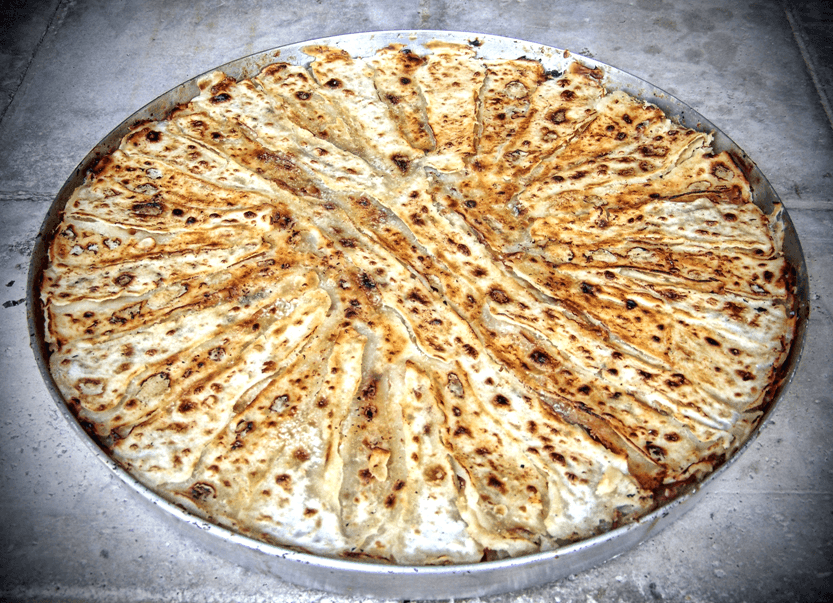
Making flia is a community activity. Traditionally, the whole family gathers around the hearth or an outdoor fire. One person spoons a thin layer of batter onto a round pan and lets it cook, then spreads clotted cream (called kaymak) on top before adding the next layer of batter. This is repeated many times until the flia is thick and golden. The process can take two or three hours.
Flia is cooked under a special domed lid called a sac (pronounced 'sach'), which has hot embers placed on top of it so the pancake bakes from above and below at the same time. The sac is a traditional piece of Balkan cooking equipment and gives flia its characteristic slightly smoky, golden crust.
A finished flia is cut into wedges like a cake and served warm. It is incredibly filling - one slice is a meal in itself. It can be eaten plain, with yoghurt, or with honey. In Kosovo, flia is especially made for celebrations, guests, and important family occasions. Serving flia to visitors is a sign of great hospitality.
Every family in Kosovo has its own flia recipe, passed down through generations. Some add butter between the layers, others use soured cream, and some add herbs. The debate over whose family makes the best flia is a friendly and ongoing one across the whole country.