
Classroom lesson ยท Wildlife ยท ๐Ÿ‡ฑ๐Ÿ‡พ Libya

Egyptian Vulture

A clever bird that uses tools to crack open eggs

Photo ยท Wikimedia Commons

What is it?

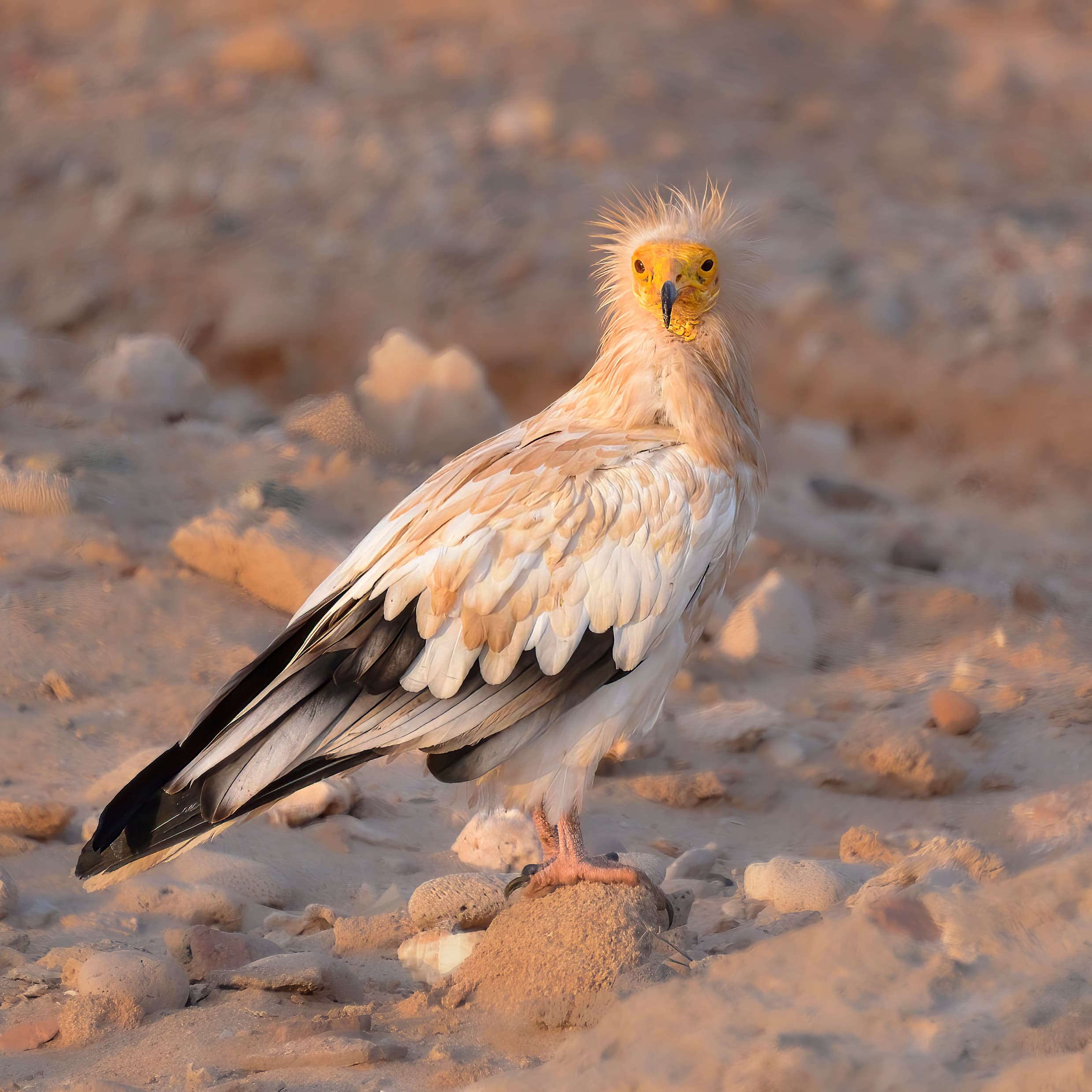
The Egyptian vulture is a striking white-and-black bird with a bright yellow face that soars over Libya's deserts and coastline. It is one of the few birds in the world known to use tools โ€” it picks up stones in its beak and throws them at eggs to break the shell open so it can eat what is inside.

Tell me more

Egyptian vultures are medium-sized birds with a wingspan of about 170 cm โ€” roughly the arm span of an adult human. The yellow skin on their face is actually bare โ€” no feathers โ€” and it can change colour to signal their mood to other vultures. A brighter yellow often means a healthier, more confident bird.

Their tool use is what makes scientists especially excited. When Egyptian vultures find a large egg that is too hard to open with their beak alone, they pick up a stone, raise their head, and throw the stone at the egg โ€” repeatedly โ€” until the shell cracks. Only a handful of bird species in the world use tools in this way.

Egyptian vultures are scavengers, meaning they mainly eat things that are already dead. This sounds unpleasant, but vultures play an incredibly important role in nature: they clean up the landscape very quickly, preventing the spread of germs and keeping the environment healthy for other animals.

These birds migrate across vast distances โ€” some travel from Europe and the Middle East to spend winter in Africa, passing over Libya on the way. They have been admired for thousands of years; ancient Egyptians saw them as sacred birds and included them in their hieroglyphs.

In the classroom

Walk your class through this in 15 minutes.

Talk together

Discussion prompts

  1. 01Egyptian vultures use rocks as tools. What other animals do you know that use tools? What does that tell us about animal intelligence?
  2. 02Vultures are scavengers. Why do you think nature needs animals that clean up dead things?
  3. 03Ancient Egyptians put vultures in their writing system. What animal would you choose to represent something in a picture language, and what would it mean?
Try this

Classroom activity

Create a short picture story (six panels, no words) showing an Egyptian vulture finding an ostrich egg, collecting a stone, cracking the egg, and eating. Think carefully about the sequence and use arrows or motion lines to show the action.