
Classroom lesson Β· Music Β· πŸ‡²πŸ‡» Maldives

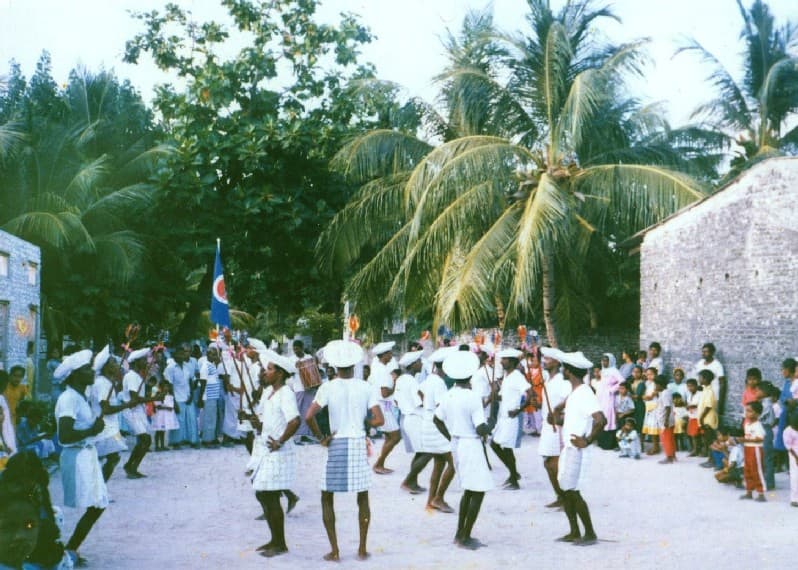
Bodu Beru

Big drums, chanting, and dancing that shakes the whole island

Photo Β· Wikimedia Commons

What is it?

Bodu Beru means 'big drum' in Dhivehi, and it is the most exciting traditional music of the Maldives. A group of drummers play three or more large cylindrical drums together, starting slowly and building to a pounding, thunderous rhythm. Singers chant along, and dancers spin and sway until the energy fills the whole gathering.

Tell me more

A traditional bodu beru performance begins calmly β€” just a few soft beats and a gentle chant. As more drummers join and the rhythm speeds up, the music takes on an almost irresistible energy. By the peak, the drums are thundering, the singing is full-voiced, and dancers have entered a state of uninhibited movement, sometimes spinning so fast they lose track of everything around them.

The drums themselves are cylindrical, made from a hollowed-out coconut trunk covered at each end with stingray or sharkskin. Each drum produces a deep, resonant boom. Three drums together β€” played at slightly different speeds and accents β€” create an interlocking rhythm that is complex and hypnotic.

Bodu beru has roots in the cultural exchanges between the Maldives, East Africa, and Southern Asia that have taken place for centuries, carried by the trade winds that blow across the Indian Ocean. The call-and-response structure of the singing shows African musical influences, while some of the drum patterns have links to South Asian traditions.

Today, bodu beru is performed at celebrations β€” Independence Day, weddings, national festivals β€” and is taught in schools so young Maldivians can keep the tradition alive. Groups compete at festivals, and the best drummers are admired throughout the islands.

In the classroom

Walk your class through this in 15 minutes.

Talk together

Discussion prompts

  1. 01Bodu beru music starts slowly and gets faster and louder β€” how does speed and volume change the way music makes you feel?
  2. 02The music carries influences from Africa and Asia. How do you think music and culture travelled across the ocean before aeroplanes existed?
  3. 03What musical traditions does your community have that are passed down from older generations?
Try this

Classroom activity

Classroom bodu beru! Divide into three groups, each with a different percussion instrument (or just tapping on tables). Group 1: slow steady beat. Group 2: joins after 30 seconds, twice as fast. Group 3: joins after 60 seconds with a syncopated accent. A fourth group is the 'choir' β€” improvise a chant on top. Build the piece for 2 minutes, then let it fade back to silence the same way it started.