
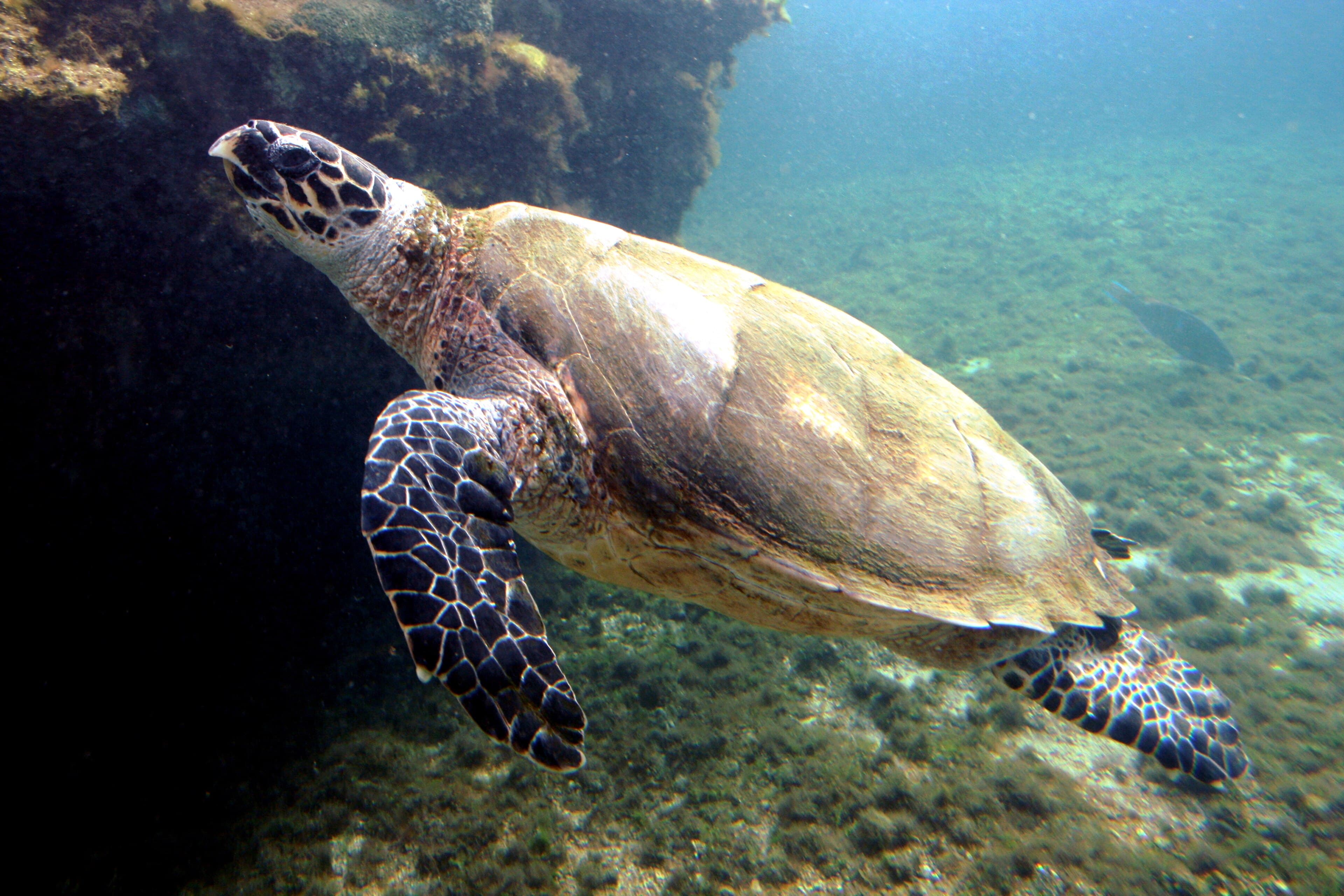
Hawksbill turtles have richly patterned shells with overlapping plates in shades of amber, brown, and gold. Their narrow beaks are perfect for reaching into crevices in the coral to prise out sponges, which most other animals cannot eat because sponges contain sharp glass-like spicules. By eating sponges, hawksbills help keep the reef balanced, making space for coral to grow where sponges might otherwise take over.
Sea turtles are air-breathing reptiles, so they must surface to breathe even though they spend their whole lives in the water. A resting hawksbill can hold its breath for several hours, but an active turtle surfaces every few minutes. You can sometimes spot them at the surface, stretching their neck up to take a breath before diving again.
Female hawksbill turtles come ashore at night on sandy beaches to lay their eggs in a nest they dig with their flippers. They return to the same beaches where they were born - navigating across thousands of kilometres of open ocean using the Earth's magnetic field like an invisible map. After the eggs hatch, the tiny baby turtles head straight for the water.
In the Maldives, several resorts and conservation groups run turtle monitoring programmes. Researchers tag turtles so they can track their movements. Local children sometimes take part in watching nesting beaches - and the thrill of seeing a turtle lay eggs or tiny hatchlings rushing into the sea stays with them for life.