
Classroom lesson · Wildlife · 🇵🇾 Paraguay

Giant Anteater

The long-tongued insect expert of the Chaco

Photo · Wikimedia Commons

What is it?

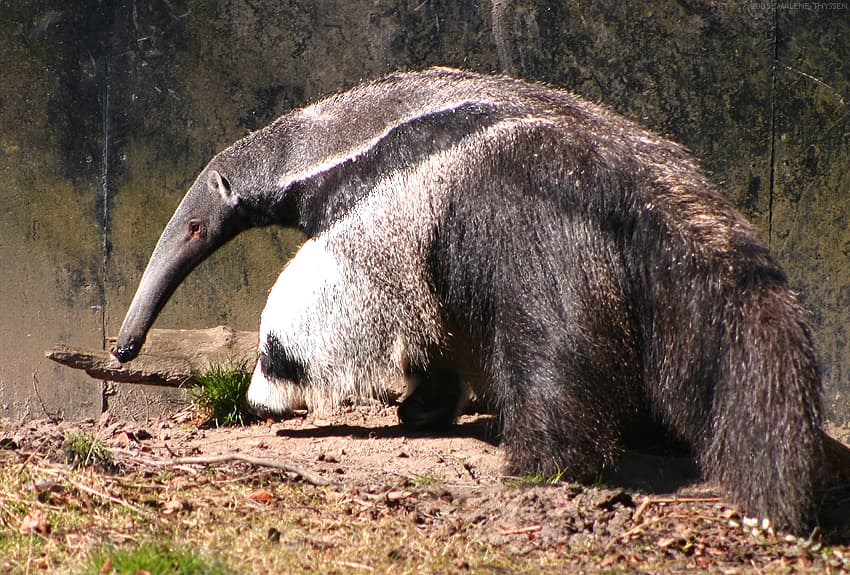
The giant anteater is one of the most extraordinary-looking animals in Paraguay. It has no teeth at all, a tube-shaped snout as long as a ruler, and a tongue that can flick in and out 150 times a minute to scoop up ants and termites. Its bushy tail is so big it looks almost like a second body.

Tell me more

A giant anteater can eat up to 35,000 ants and termites in a single day. It does this by slashing open a termite mound with its enormous curved claws — which are so big and strong they are also used for self-defence — then pushing its long sticky tongue deep inside. The tongue is covered in thousands of tiny backward-pointing barbs and coated with thick, sticky saliva, so insects stick to it instantly.

Giant anteaters have very poor eyesight, but their sense of smell is about 40 times stronger than a human's. They use it to find termite mounds hidden under soil and leaves. Mother anteaters carry their single baby on their back for up to a year — the baby's fur pattern lines up with the mother's so that from a distance the two look like one animal, which confuses predators.

In Paraguay, giant anteaters live in the Chaco grasslands and the cerrado, a type of wooded savannah. They are not fast runners, but they are surprisingly good swimmers and can cross wide rivers. Conservation teams in Paraguay fit some anteaters with GPS trackers to map where they roam, and local schools near the Chaco learn about anteater protection as part of their science lessons.

In the classroom

Walk your class through this in 15 minutes.

Talk together

Discussion prompts

  1. 01The giant anteater has no teeth — how does it manage to get all its food without chewing?
  2. 02A baby anteater's fur pattern matches its mother's — why might camouflage like this be useful?
  3. 03If you could have a sense that was 40 times better than normal (smell, sight, or hearing), which would you choose and how would you use it?
Try this

Classroom activity

Time yourself licking pretend 'ants' (small paper dots) off a flat surface using only a wet finger for 10 seconds. Count how many you collected. Now calculate: if an anteater's tongue is roughly 60 cm long and 40 times stickier — how many more could it collect? Make up your own maths challenge based on the anteater.