
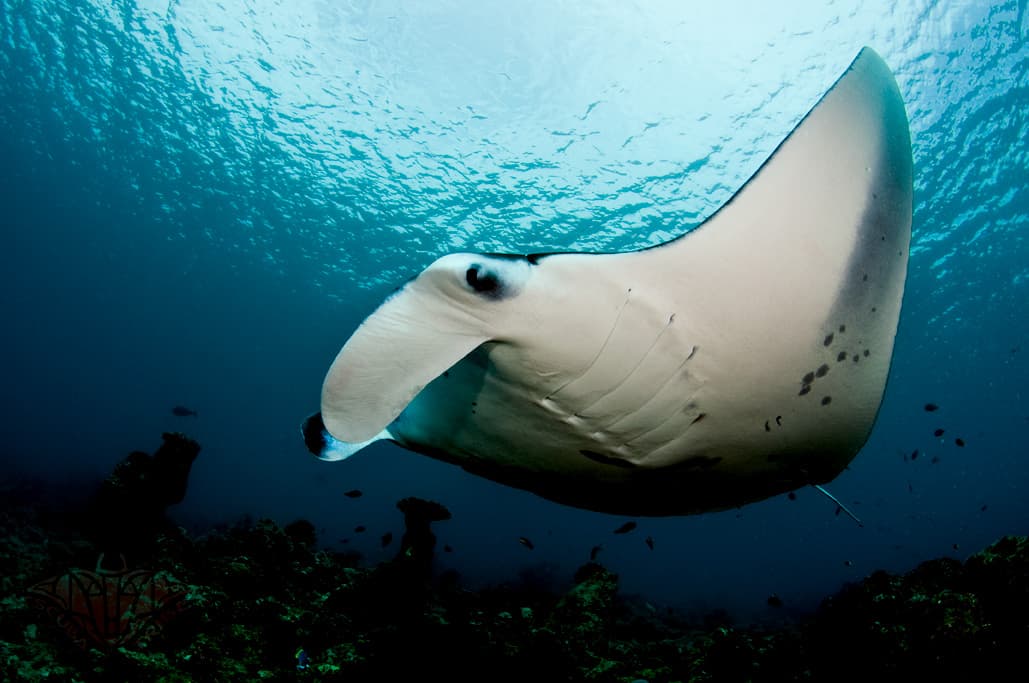
Manta rays have a pair of horn-shaped fins on either side of their head called cephalic fins, which they use to funnel plankton - tiny ocean creatures - into their mouths as they swim. Their mouths are very wide but their throats are narrow, so they eat only the very smallest things in the sea. A manta ray is completely harmless to people.
In the channels and current-swept passes around Atauro Island and the eastern tip of Timor-Leste, manta rays come to feeding stations where plankton is especially rich. Divers descend and simply wait very still as the mantas circle overhead, occasionally passing close enough to see the patterns on their white belly - each belly pattern is unique to that individual ray, like a fingerprint.
Manta rays have the largest brains of any fish, and researchers believe they may be one of the most intelligent fish in the ocean. They have been observed returning to the same cleaning stations - places on a reef where small fish eat the parasites off the manta's skin - year after year, suggesting they remember locations.
Manta rays are slow to reproduce - a female gives birth to just one pup at a time, and may only do so every few years. This means that protecting them is very important, because it takes a long time for manta ray numbers to recover if they are disturbed.