
Classroom lesson 路 Wildlife馃嚮馃嚜 Venezuela

Giant anteater

A tube-nosed mammal with a tongue longer than your arm

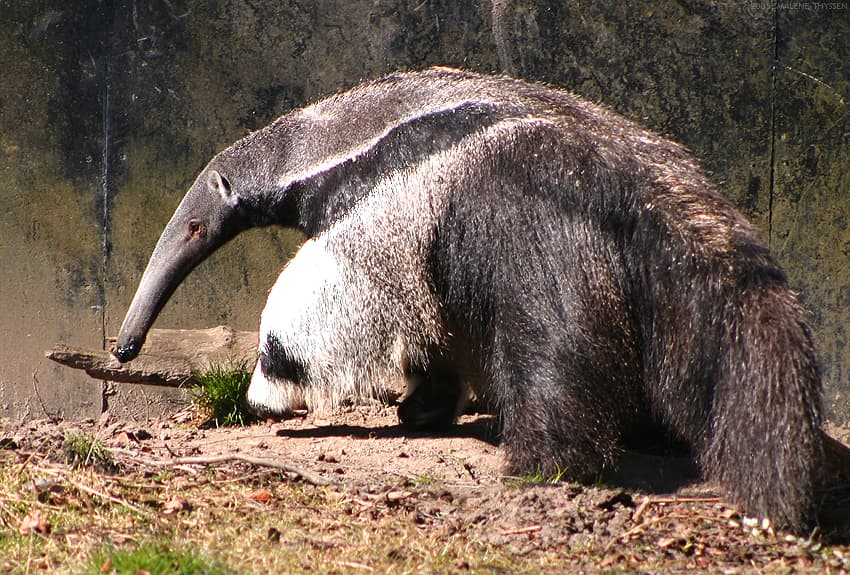
Photo 路 Wikimedia Commons

What is it?

The giant anteater is a long, low, shaggy mammal that walks across the grasslands of Venezuela and the rest of South America with its nose to the ground. From nose to tail it can be over 2 metres long. Its big bushy tail is almost like a second body. It eats only one thing - ants and termites - and it has a brilliant tool for the job: a 60 cm sticky tongue.

Tell me more

An anteater's tongue is about as long as your arm. The tongue is covered in tiny backward-pointing hooks and a layer of sticky spit. The anteater flicks it in and out of a termite mound up to 150 times a minute, scooping up insects with every flick. It can eat 30,000 ants in a single day.

Anteaters do not have teeth. They don't need them - they swallow their food whole, and tough muscles inside their stomach grind it up. Their mouth is a tiny circle at the very tip of their long snout, just big enough for the tongue.

Their claws are huge - more than 10 cm long. They use them to rip open termite mounds, which are as hard as concrete. The claws are so long that when they walk, the anteater has to curl them up so it walks on the side of its foot, like someone walking on the side of a curled-up hand.

Mother anteaters carry their babies on their back for around a year. The baby's fur is the same colour and pattern as the mother's, so when the two of them stand still, they look like a single bigger animal. It is one of the cleverest disguises in nature.

In the classroom

Walk your class through this in 15 minutes.

Talk together

Discussion prompts

  1. 01Why might an animal that only eats ants need such a special tongue?
  2. 02Anteaters don't have teeth. What other animals have surprising 'missing tools' that work fine anyway?
  3. 03A baby anteater rides on its mum's back and looks like part of her. Why might that disguise help keep it safe?
Try this

Classroom activity

Measure 60 cm of string and stick it to one end of a paper cut-out of an anteater's head. Use it as a tongue! Practice flicking it onto pictures of ants on a table - how many can you 'pick up' in 30 seconds? Then count out 30,000 grains of rice (kidding) to imagine an anteater's daily meal.