
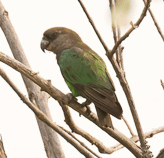
African grey parrots are famous for their ability to copy human speech - but what makes them remarkable is that they do not just repeat words like a recording. Research has shown they can actually understand what many words mean and use them correctly. Famous grey parrots in science experiments have been able to identify shapes, colours and materials and ask for specific objects by name.
In the wild, African grey parrots live in flocks and are incredibly social. They use a wide range of calls, whistles and squawks to communicate with each other - signalling where food has been found, warning the flock of danger and keeping the group together as they fly between trees. Each flock develops its own set of calls that outsiders may not recognise, a bit like a local dialect.
Grey parrots eat fruit, nuts, seeds and berries. They use their strong, curved beak like a third hand - gripping a branch or a piece of food with their beak while their feet hold on elsewhere. Their toes are arranged two-forward, two-backward, which gives them an exceptionally strong grip and lets them hang upside down to reach fruit that other birds cannot get to.
In the rainforests of the Central African Republic, African grey parrots nest in tree hollows high up in the canopy. Their grey colouring helps them blend in with the bark of tall trees, which makes them surprisingly hard to spot even when they are sitting completely still.