
Classroom lesson ยท Bioko Greater Bushbaby ยท ๐Ÿ‡ฌ๐Ÿ‡ถ Equatorial Guinea

Bioko Greater Bushbaby

A big-eyed night creature found only on Bioko Island

Photo ยท Wikimedia Commons

What is it?

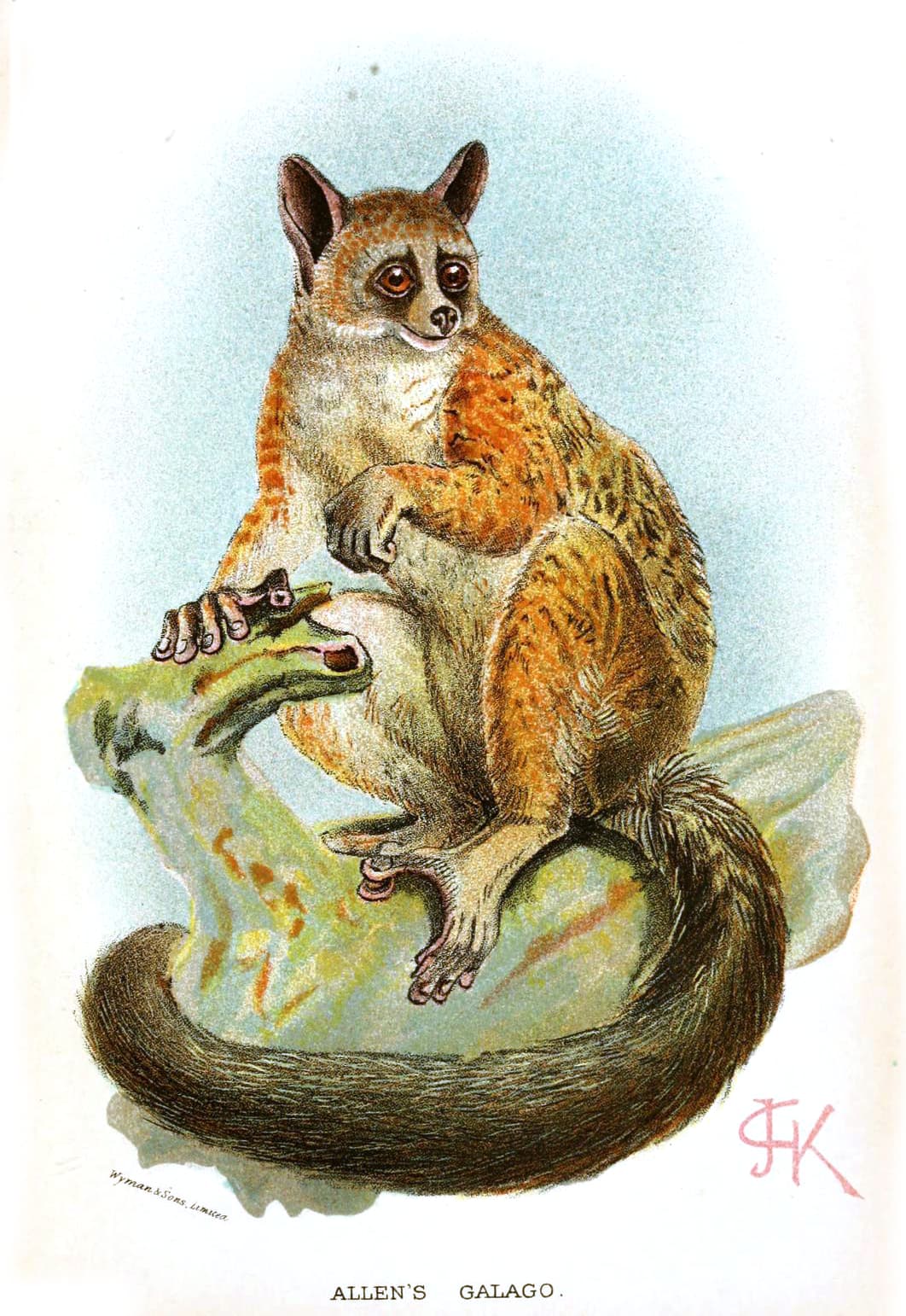
The Bioko greater bushbaby is a small primate found only on Bioko Island โ€” it does not live anywhere else in the world. It has enormous round eyes that glow in the dark, soft thick fur, and very long back legs that let it leap through the forest at night like a tiny acrobat. Its call sounds almost like a baby crying, which is how bushbabies got their name.

Tell me more

The Bioko greater bushbaby is a type of galago, a group of small night-time primates related to lemurs. It weighs only about 150 to 200 grams โ€” less than a can of fizzy drink โ€” but can leap over 2 metres in a single jump. Its enormously large eyes are packed with light-sensitive cells that let it see clearly in the darkest forest, collecting every tiny glimmer of moonlight.

Unlike our eyes, a bushbaby's eyes cannot move in their sockets โ€” they are fixed in place. Instead, the bushbaby rotates its whole head, owl-style, to look in different directions. It can turn its head almost 180 degrees. It also has very large bat-like ears that can move independently, helping it locate insects and other small creatures by sound in complete darkness.

Bushbabies are expert hunters of insects at night. They creep silently along branches, then snatch a moth or beetle out of the air with lightning-fast hands. They also eat fruit, tree gum (which they gouge from bark with their teeth), and sometimes small lizards. Bushbabies are largely solitary but communicate with each other through calls and scent markings on branches.

Because it is only found on Bioko Island, the Bioko greater bushbaby is particularly special to protect. Scientists regularly survey the island's forest at night using torches to count the glowing eyes in the trees โ€” a counting method called 'night transect surveys'. Every pair of eyes represents a bushbaby going about its busy nocturnal life.

In the classroom

Walk your class through this in 15 minutes.

Talk together

Discussion prompts

  1. 01Bushbabies cannot move their eyes but can rotate their heads 180 degrees. What are the advantages and disadvantages of each approach compared to how human eyes work?
  2. 02Why might very large eyes be helpful for an animal that is active at night?
  3. 03If an animal can only be found on one island in the whole world, why does that make it especially important to protect?
  4. 04Scientists count bushbabies by looking for their glowing eyes at night. Can you think of another way scientists might count nocturnal animals?
Try this

Classroom activity

Compare three night-time hunters: the Bioko greater bushbaby, an owl, and a bat. Make a table showing how each one uses eyes, ears, and other senses to find food in the dark. Circle any similarities between all three and underline any features that are unique to one animal.