
Classroom lesson ยท Wildlife ยท ๐Ÿ‡ฒ๐Ÿ‡ท Mauritania

Addax Antelope

A pale desert wanderer with spiral horns

Photo ยท Wikimedia Commons

What is it?

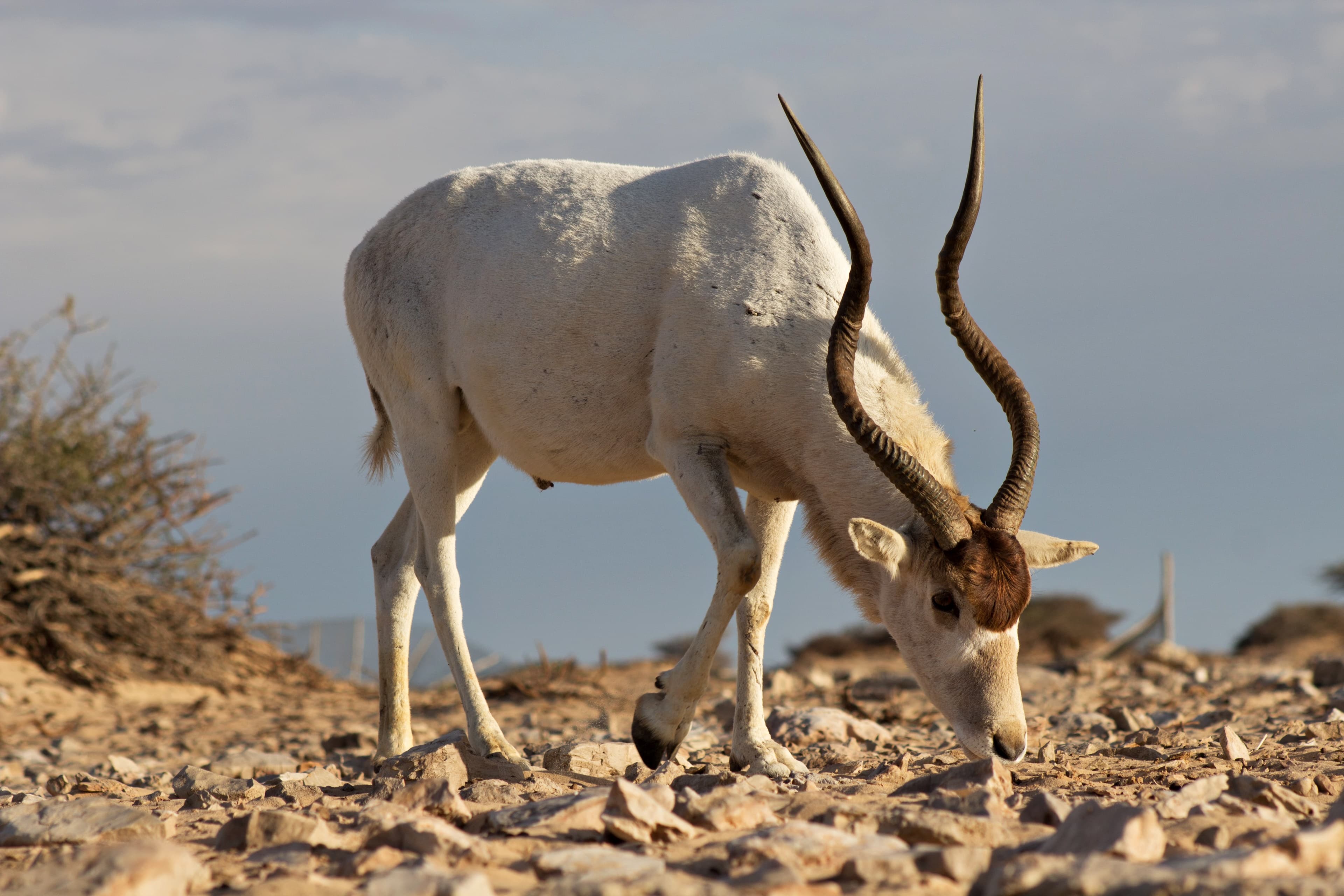
The addax is a beautiful antelope that lives in the Sahara Desert and is perfectly built for life with almost no water. It has pale, almost white fur that reflects the sun, wide flat hooves for walking on soft sand, and spectacular spiralling horns that can grow nearly a metre long. Mauritania is one of the last places on Earth where wild addax can still be found.

Tell me more

Addax are sometimes called the 'desert ghost' because they wander huge distances, following rare rains across the Sahara. They can sense when rain has fallen far away and travel towards it to reach freshly sprouted grass. Scientists are not entirely sure how they do this โ€” it may be smell, or changes in the air.

Like the fennec fox, the addax can live without drinking water for long periods, getting moisture from the plants it eats. Its kidneys are very efficient at saving water inside the body. Its white-and-sandy coat helps reflect heat in summer; in winter the coat grows darker to absorb warmth from the sun.

Addax move in small herds and use their broad, shovel-like hooves to walk on soft sand without sinking. Compared to thinner-hooved animals, they move through desert sand the way snowshoes help people walk on snow.

There are sadly very few addax left in the wild today โ€” perhaps only a handful in the whole Sahara. But conservation projects in Mauritania and neighbouring countries are working to protect and increase their numbers, and some addax have been bred safely in special reserves and reintroduced.

In the classroom

Walk your class through this in 15 minutes.

Talk together

Discussion prompts

  1. 01The addax changes colour with the seasons. Why might a pale coat be useful in summer but a darker coat help in winter?
  2. 02Why do you think wide flat hooves help an animal walk on sand? What human invention works the same way?
  3. 03Conservation groups are helping the addax recover. What would happen to desert ecosystems if the addax disappeared completely?
Try this

Classroom activity

Hold a class 'nature engineering' challenge. Give pairs of pupils a large tray of dry rice or sand and some modelling clay. Ask them to design and build a 'hoof' that spreads weight as widely as possible, then test it by pressing it gently into the tray. Compare which design sinks least.