
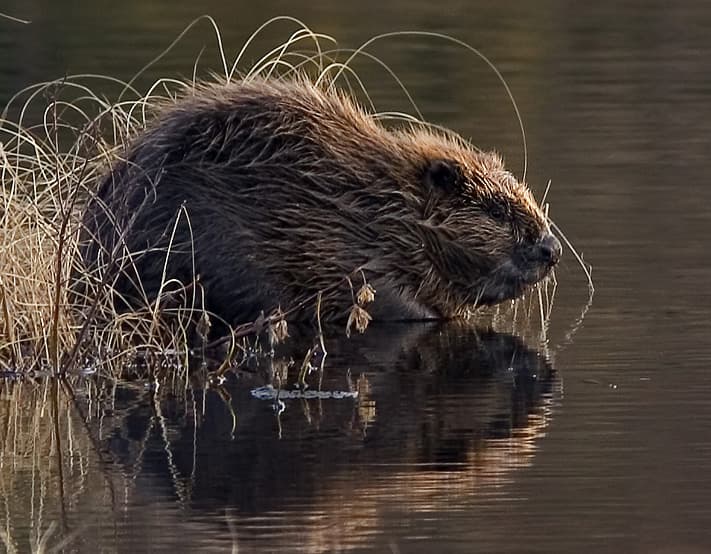
A beaver's front teeth are orange-coloured because they contain iron, which makes them extra hard and strong. The teeth grow continuously throughout the beaver's life - which is useful, because gnawing through tree trunks wears them down constantly. A beaver can cut through a small tree in just a few minutes, leaving behind a pointed stump that looks like a sharpened pencil.
The dam a beaver builds is a remarkable feat of engineering. The beaver packs sticks, branches, mud and stones together to create a barrier across the stream. Water backs up behind the dam to form a pond. The pond has to be deep enough not to freeze solid in winter - the beaver stores food underwater and needs to be able to swim under the ice to reach it.
In the middle of the pond stands the lodge - a dome of sticks and mud with an underwater entrance. From the outside it looks like a pile of branches. Inside, above the waterline, there is a dry, warm chamber where the family sleeps and the young kits grow up. Because the entrance is underwater, no fox or wolf can simply walk in.
Eurasian beavers almost disappeared from Moldova in the past because they were hunted for their thick fur. Conservationists worked hard to bring them back by releasing beavers into suitable rivers and protecting them. Now they are found along several of Moldova's rivers and in the Codru forest area. A beaver pond also benefits many other animals - frogs, dragonflies, herons and otters all use the habitat beavers create.