
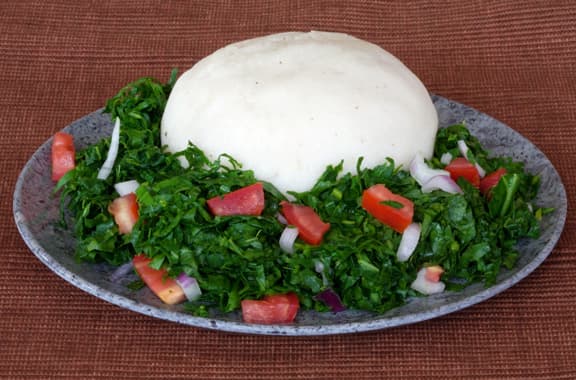
Making xima requires skill and patience. Maize flour is stirred into boiling water and then beaten continuously with a long wooden spoon called a colher de pau. The cook must keep stirring without stopping as the mixture thickens, otherwise lumps form. When it is done correctly, xima is perfectly smooth and holds its shape when scooped onto a plate.
Xima is eaten with the right hand in traditional Mozambican style. You pinch off a small piece, roll it into a ball with your fingers, press a hollow into it with your thumb, and use it like a little cup to scoop up whatever sauce is beside it - matapa, bean stew, fish curry, or slow-cooked vegetable dishes.
Maize was brought to Africa from the Americas hundreds of years ago, but it has completely become part of the landscape and the food culture. Fields of maize grow across Mozambique's countryside, and families often dry and grind their own corn into flour using hand-operated or powered mills.
Xima gives energy that lasts for hours, which is important for people who do physical work like farming or fishing. It is filling, cheap, easy to make in large quantities, and delicious when paired with a flavoursome sauce. In Mozambique, a meal without xima is not quite a proper meal.