
Classroom lesson · Wildlife · 🇪🇭 Western Sahara

Houbara Bustard

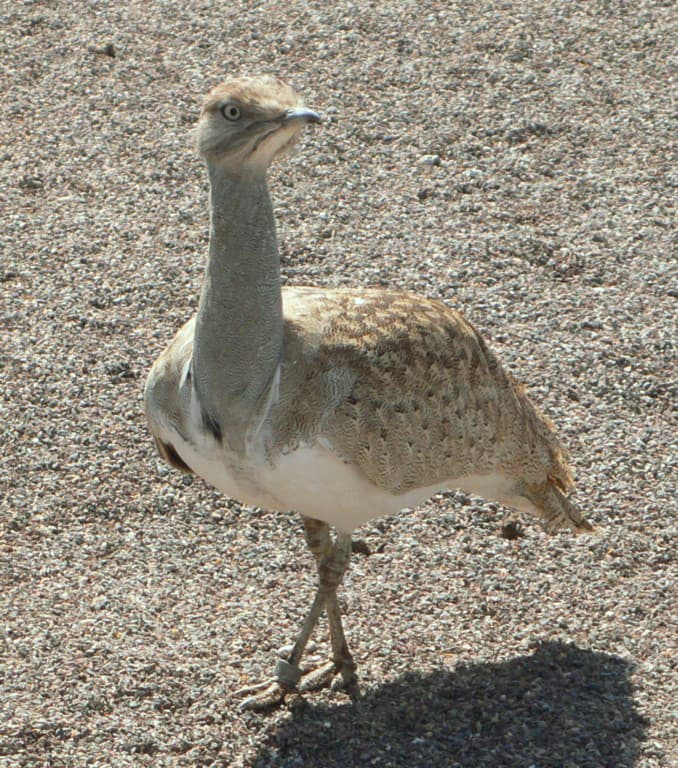
A desert bird famous for its spectacular courtship dance

Photo · Wikimedia Commons

What is it?

The houbara bustard is a large, sandy-coloured bird that lives in open desert and dry scrubland across North Africa and the Middle East. It is well camouflaged against the desert ground. The male houbara is famous for one of the most dramatic courtship displays in the bird world — he puffs up his white neck feathers and runs in circles at high speed.

Tell me more

Houbara bustards are about the size of a large chicken. They spend most of their time walking slowly across the desert searching for beetles, lizards, seeds, and berries. When they are alarmed, they freeze and crouch low rather than flying away immediately — their sandy feathers blend so well with the desert ground that they almost disappear.

During the breeding season, the male transforms. He fans out the long white feathers around his neck like a huge pom-pom, drops his wings, and runs forward in tight circles or zigzags. This energetic, almost comedic display can last for hours and attracts females from a distance.

Houbara bustards are good at surviving without much water. They eat plants and insects that contain moisture and can travel long distances in search of food. Conservation programmes in several countries carefully monitor houbara populations and breed them in special centres to help keep their numbers healthy.

In the classroom

Walk your class through this in 15 minutes.

Talk together

Discussion prompts

  1. 01The houbara freezes and relies on camouflage instead of flying away. What are the advantages and disadvantages of hiding versus running?
  2. 02The male bird does a dramatic dance to attract a partner. Can you think of other animals that use dancing or displays?
  3. 03Why might conservationists breed rare birds in special centres before releasing them into the wild?
Try this

Classroom activity

Play a camouflage spotting game. Cut out fifteen small animal shapes from different coloured paper. Scatter them on a large sheet of patterned wrapping paper. Which colours are hardest to spot? Which are easiest? Write down your results.