
Classroom lesson Β· Wildlife Β· πŸ‡¦πŸ‡« Afghanistan

Snow Leopard

The ghost of the mountains β€” rarely seen, perfectly camouflaged

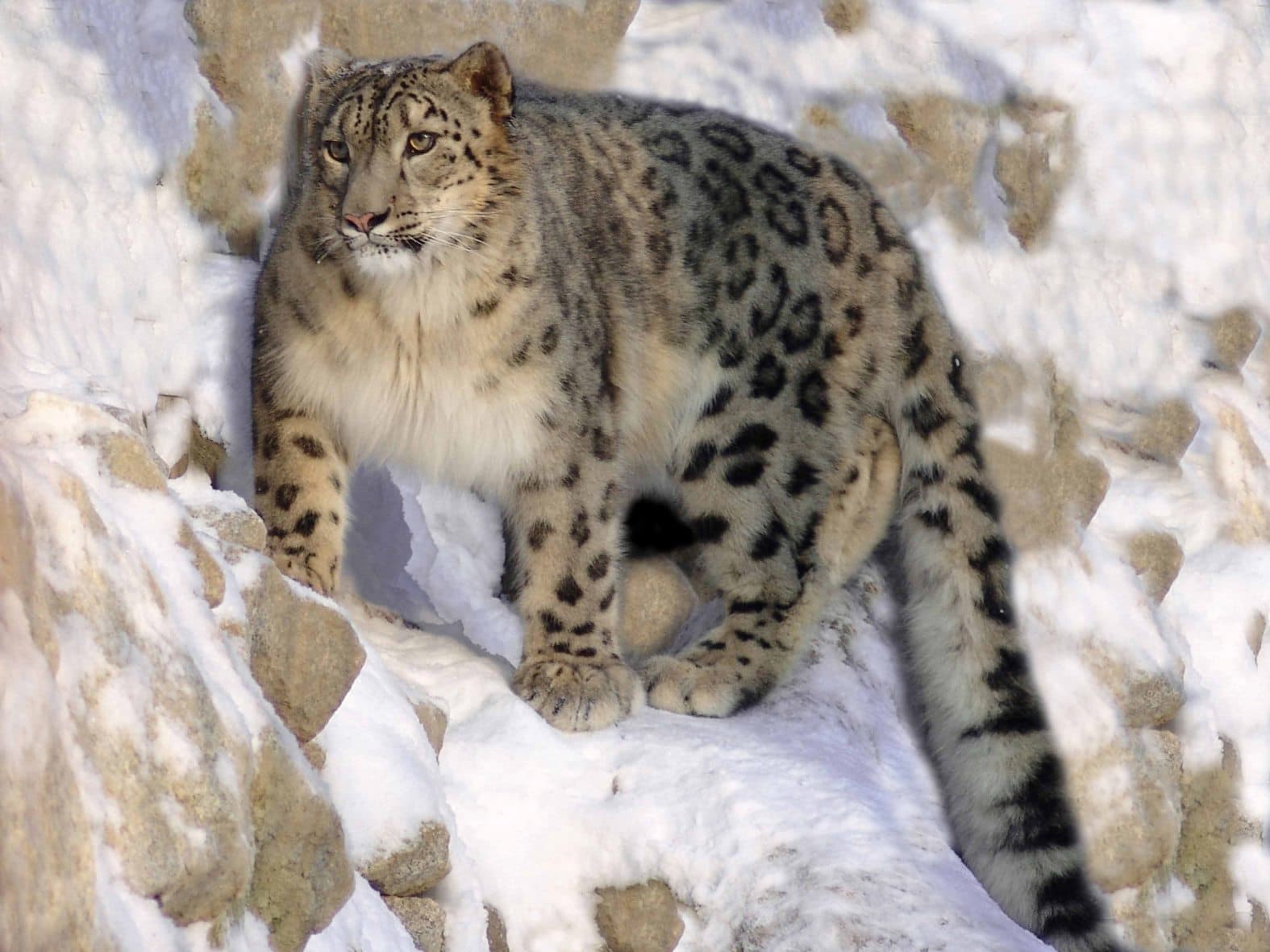
A snow leopard sitting on a rocky ridge, its spotted grey coat blending with the stone

Photo Β· Wikimedia Commons

What is it?

The snow leopard is a large wild cat that lives high up in the mountains of central Asia, including the Hindu Kush and Wakhan ranges of Afghanistan. Its thick, pale-grey coat is covered in dark rosette spots that make it almost invisible against the rocky slopes. Snow leopards are so rarely spotted by humans that they are nicknamed 'the ghost of the mountains'.

Tell me more

Snow leopards have several special features that help them survive at high altitude. Their wide, furry paws work like snowshoes, spreading their weight across soft snow. Their enormously long, thick tail β€” almost as long as their whole body β€” helps them balance on narrow ledges and also wraps around them like a scarf when they curl up to sleep in the cold.

These cats are superb athletes. They can leap up to 14 metres in a single bound β€” about the length of a school bus β€” when chasing prey across rocky slopes. Their chest is deep and wide to fit extra-large lungs, because the air high in the mountains contains much less oxygen than the air at sea level.

Snow leopards are solitary animals: they live alone and travel huge distances through the mountains. A single snow leopard may roam over an area of several hundred square kilometres, leaving scrawls on rocks with their claws and spray marks to tell other leopards 'this territory is taken'. Camera traps β€” cameras triggered automatically by movement β€” are how scientists study them today.

In the classroom

Walk your class through this in 15 minutes.

Talk together

Discussion prompts

  1. 01The snow leopard's coat helps it hide on rocky slopes. Can you think of three other animals whose colour or pattern helps them hide in their habitat?
  2. 02Snow leopards use scratch marks and scent to communicate with other leopards. How do humans mark their territory or personal space?
  3. 03Scientists use camera traps to study snow leopards without disturbing them. Why might it be important to study animals without them knowing you are there?
Try this

Classroom activity

Design your own 'mountain animal' on paper. Give it three physical features that help it survive at high altitude with cold temperatures, thin air and rocky, snowy ground. Label each feature and explain what it does. Share your design with the class and vote on the most clever adaptation.