
Classroom lesson · Fish River Canyon · 🇳🇦 Namibia

Fish River Canyon

The second-largest canyon in the world, carved over millions of years

Photo · Wikimedia Commons

What is it?

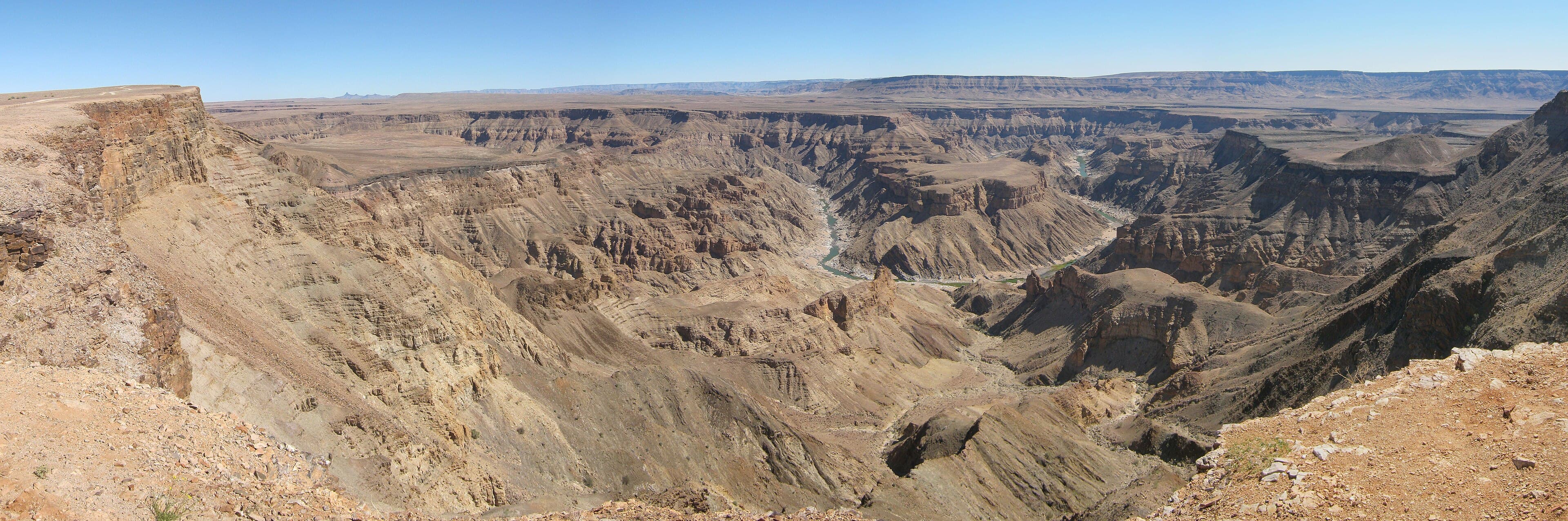
Fish River Canyon in southern Namibia is the second-largest canyon in the entire world, after the Grand Canyon in the United States. It is about 160 kilometres long, up to 27 kilometres wide, and 550 metres deep. The Fish River has been carving through the rock for hundreds of millions of years to create this enormous valley.

Tell me more

A canyon is formed when a river slowly cuts down through rock over a very long time. The Fish River started cutting into the land around 500 million years ago, though the canyon we see today mainly formed in the last few million years. That means the canyon was already ancient before the dinosaurs even existed.

Standing at the rim and looking down, everything looks tiny — including the river far below. The walls of the canyon are made of different layers of rock, each layer a different colour, showing different periods of Earth's history stacked on top of each other like the pages of a very old book.

The canyon is home to lots of wildlife. Baboons scramble along the rocky ledges, klipspringers (small antelopes) leap between boulders with amazing balance, and leopards have been spotted in the more remote sections. The river at the bottom provides a ribbon of green life in the surrounding dry landscape.

At the southern end of the canyon there is a place called Ai-Ais, meaning 'fire water' in the Nama language, where natural hot springs bubble up from underground. The warm mineral water has been a welcome resting spot for travellers for thousands of years.

In the classroom

Walk your class through this in 15 minutes.

Talk together

Discussion prompts

  1. 01A river carved this canyon over millions of years just by flowing over rock. What does that tell you about what water can do over a very long time?
  2. 02The rock layers are like pages in a book of Earth's history. What do you think scientists can learn by reading those layers?
  3. 03If you were a klipspringer, what skills would you need to live on steep rocky cliffs?
Try this

Classroom activity

Make a layered 'canyon rock' model using different colours of playdough or clay. Stack at least five different colours to represent rock layers, then press a pencil down through the middle and slowly widen it to show how a river carves a canyon. Label each layer with a colour and invent a name for that 'rock type'.