
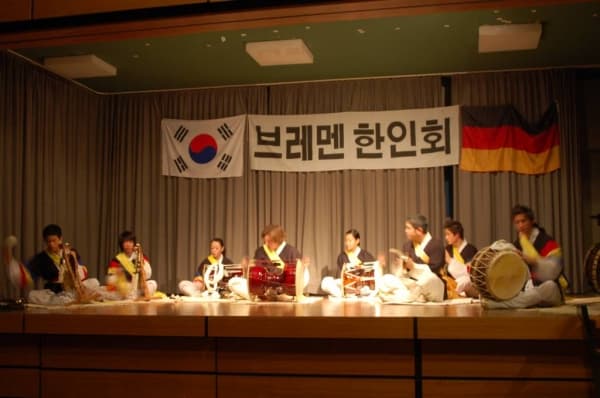
Classroom lesson · Samul Nori · 🇰🇵 North Korea

Samul Nori

Korea's electrifying four-drum percussion tradition

Photo · Wikimedia Commons

What is it?

Samul nori is a thrilling Korean style of music played by four percussionists using four traditional instruments. The players wear bright costumes and perform together in tightly woven, fast-changing rhythms that build from gentle to electrifying. The name means 'playing with four objects', and the four instruments together make a complete, balanced sound.

Tell me more

The four instruments are the kkwaenggwari (a small hand-held gong), the jing (a large hanging gong), the janggu (an hourglass-shaped drum) and the buk (a large barrel drum). In traditional Korean thought, these four instruments together represent rain, wind, thunder and clouds — the sounds of nature and sky.

Samul nori rhythms are built on repeating patterns called 'jangdan'. The musicians listen closely to each other and weave their patterns together, with one player leading changes. The music often starts slowly and softly before speeding up to a furious, joyful climax.

Performers sometimes wear long white ribbons attached to their hats and spin their heads as they play, making the ribbons spiral through the air in beautiful arcs. This tradition comes from farmers' band music performed at harvest celebrations and village festivals.

Samul nori developed from older travelling performer traditions and became widely popular from the 1970s onwards. Today it is taught in schools and performed on concert stages. Children often learn the janggu drum as their first samul nori instrument.

In the classroom

Walk your class through this in 15 minutes.

Talk together

Discussion prompts

  1. 01The four samul nori instruments are said to sound like rain, wind, thunder and clouds. Which instrument do you think sounds like which? Why?
  2. 02Samul nori musicians listen very carefully to each other. What other activities need that kind of close listening and teamwork?
  3. 03The music builds from slow to very fast. How does speeding up change the feeling of a piece of music? Try clapping a simple rhythm slowly, then double the speed.
Try this

Classroom activity

Create a classroom samul nori with everyday objects: use a small bell (kkwaenggwari), a large saucepan lid (jing), a pair of pencils on a desk (janggu) and hands on knees (buk). Practise a simple interlocking pattern together, starting slow and gradually getting faster.